Portfolio Performance: TTWROR, IRR, Sharpe Ratio & Benchmark Comparison Explained
Understand TTWROR, IRR, Sharpe ratio, max drawdown, and volatility. Learn how trefolio calculates real performance and compares against S&P 500 and Euro Stoxx 50.
"Am I Actually Beating the Market?"
Your portfolio is up 15% this year. Sounds great — but is it? If the S&P 500 returned 25%, you underperformed. If you added cash mid-year, your "return" might be distorted by the timing of deposits. And what about risk? A 15% return with 30% volatility is very different from 15% with 5% volatility.
Understanding portfolio performance requires the right metrics. trefolio calculates TTWROR, IRR, Sharpe ratio, max drawdown, and volatility from your actual transactions — and compares you against S&P 500, Nasdaq, Dow Jones, and Euro Stoxx 50. No guesswork, no spreadsheets.
TTWROR Explained
Time-Weighted Rate of Return (TTWROR) measures your portfolio's performance independent of when you added or withdrew cash. It answers: "How well did my investments perform?" — not "How much money did I make?"
Why does this matter? If you deposit €10,000 in January and your portfolio doubles by December, your "simple return" is 100%. But if you deposited €50,000 in November, that same 100% gain would look very different. TTWROR eliminates cash flow distortion by breaking the period into sub-periods and chain-linking returns. It's the standard metric used by fund managers and financial advisors.
trefolio calculates TTWROR from your real buy/sell transactions and cash flows. No manual entry — import from DEGIRO, IBKR, Trading 212, or Revolut and get accurate numbers.
IRR Explained
Internal Rate of Return (IRR) is money-weighted. It accounts for the timing and size of your deposits and withdrawals. It answers: "What return did I personally achieve on the money I invested?"
IRR is useful when you want to know your personal outcome — e.g., "I put in €5,000 over 3 years and now have €6,500. What's my effective annual return?" IRR captures that. TTWROR would tell you how the market did; IRR tells you how you did given your specific cash flow pattern.
trefolio computes IRR from your transaction history. Use it alongside TTWROR to get the full picture.
Sharpe Ratio
Sharpe ratio measures risk-adjusted return. It's your excess return (above the risk-free rate) divided by volatility. A higher Sharpe means you're getting more return per unit of risk. A portfolio with 10% return and 5% volatility has a better Sharpe than one with 10% return and 20% volatility.
trefolio calculates Sharpe from your historical returns. Use it to compare strategies or to see if your portfolio is efficiently rewarded for the risk you're taking.
Max Drawdown
Max drawdown is the largest peak-to-trough decline in your portfolio value. If your portfolio went from €100,000 to €70,000 at its lowest point, your max drawdown is 30%. It's a simple, intuitive measure of "how bad did it get?" — and how long it took to recover.
Volatility
Volatility (standard deviation of returns) measures how much your portfolio fluctuates. Low volatility means smooth, predictable returns. High volatility means bigger swings — both up and down. trefolio shows annualized volatility so you can compare across time periods.
Benchmark Comparison
Beating the market is the goal for many investors. trefolio compares your TTWROR and IRR against:
- S&P 500 — US large-cap benchmark
- Nasdaq — US tech-heavy benchmark
- Dow Jones — US blue-chip benchmark
- Euro Stoxx 50 — European large-cap benchmark
See side-by-side how you're doing vs. passive index investing. Are you adding value, or would you have been better off in an ETF?
How trefolio Calculates From Real Transactions
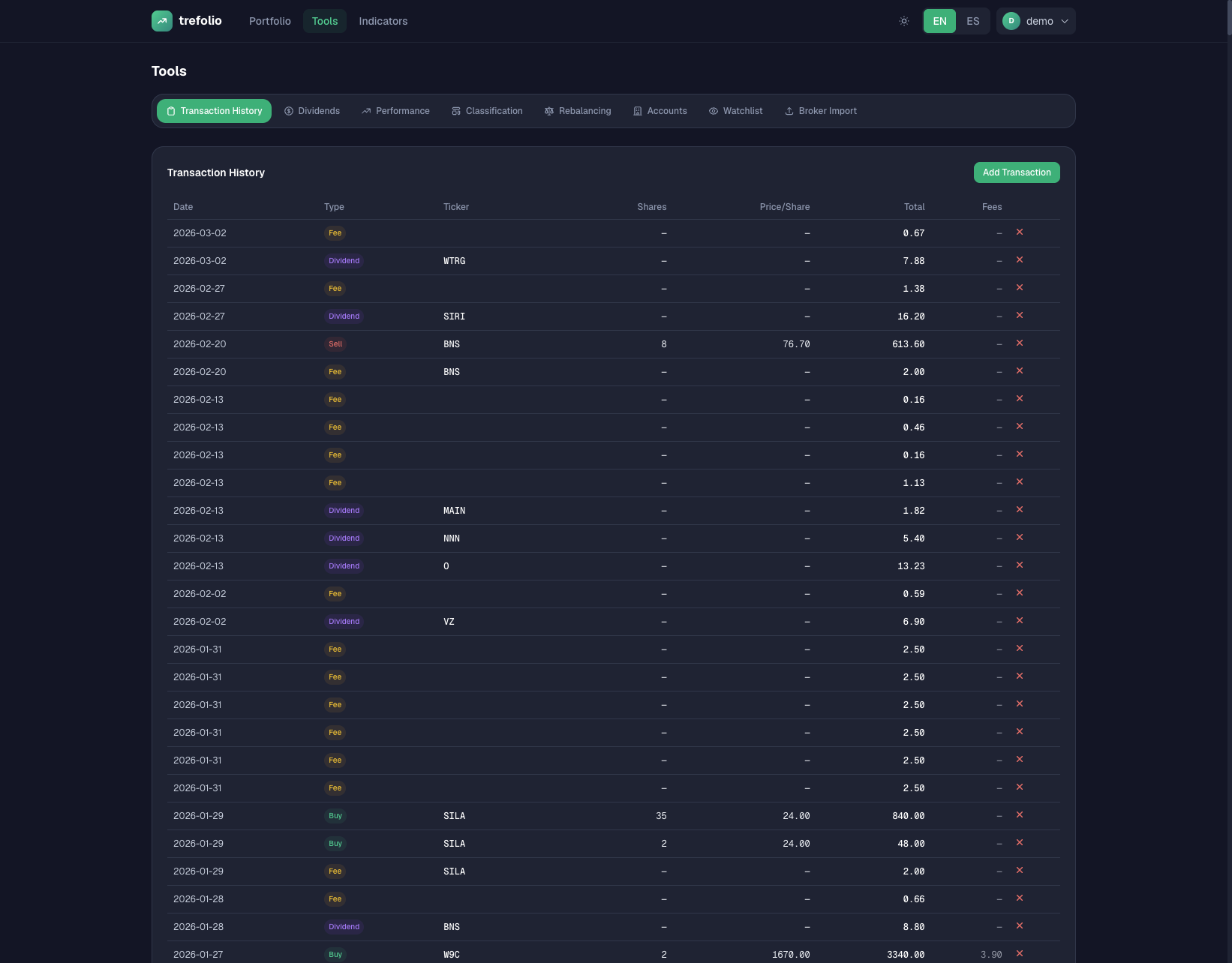
trefolio doesn't guess. It uses your actual buy/sell transactions, dividends, and cash flows from your broker import. TTWROR, IRR, Sharpe, and max drawdown are computed from this data — no manual entry, no approximations. Import from DEGIRO, IBKR, Trading 212, or Revolut and get performance metrics that reflect your real investing history.
Performance Explainer Feature
Not sure what a metric means or why your return differs from the benchmark? trefolio's performance explainer breaks it down in plain language. Click on any metric to get a short explanation and context. No finance degree required.
Step-by-Step: Viewing Your Performance
- Import your portfolio from your broker.
- Go to your dashboard — TTWROR, IRR, and daily change are shown at the top.
- Scroll to the Performance section for full metrics: Sharpe, max drawdown, volatility.
- Check the Benchmark Comparison to see how you stack up vs. S&P 500 and Euro Stoxx 50.
- Use the performance explainer for any metric you want to understand better.
Get Started
Create a free trefolio account — no credit card required. Import your portfolio and get accurate TTWROR, IRR, Sharpe ratio, and benchmark comparison from day one. The free Folio tier includes full performance metrics for up to 15 holdings. Upgrade to Trefolio for unlimited holdings and historical performance analytics.